

Your student is smart. Everyone can see it — teachers, family, your student too. So why does getting a project started feel like moving a boulder? Why do deadlines sneak up, backpacks disappear into chaos, and "I'll do it later" turn into a 2 a.m. scramble?
That gap between ability and follow-through has a name: executive function. And executive functioning coaching for students is built specifically to close it — not by teaching more content, but by teaching the underlying skills that make learning, planning, and daily life actually work.
This guide walks through what executive function coaching really is, the science behind why so many capable students struggle with it, who benefits, and how to find the right support in Wake Forest or Raleigh.
What Executive Function Coaching Actually Is (and Why It Isn't Tutoring)
Executive function coaching builds the mental skill set behind getting things done — not subject knowledge. A tutor teaches algebra. A coach teaches the student how to sit down and do the algebra homework in the first place.
Think of executive functions as the brain's project-management system: the skills that let a person set a goal, plan the steps, hold information in mind, filter out distractions, and adjust when something changes. According to the Harvard Center on the Developing Child, these are the skills that let us manage life tasks of all types — and critically, they are learned, not innate. A child is born with the potential to develop strong executive function, but the skills themselves have to be built, practiced, and coached.
That's the whole premise of executive functioning coaching for students. It's a structured, goal-based partnership that teaches planning, organizing, time management, and task initiation as skills — the same way you'd coach a sport. It is not therapy, and it is not academic tutoring layered with more worksheets.
The Core Executive Function Skills Every Student Needs
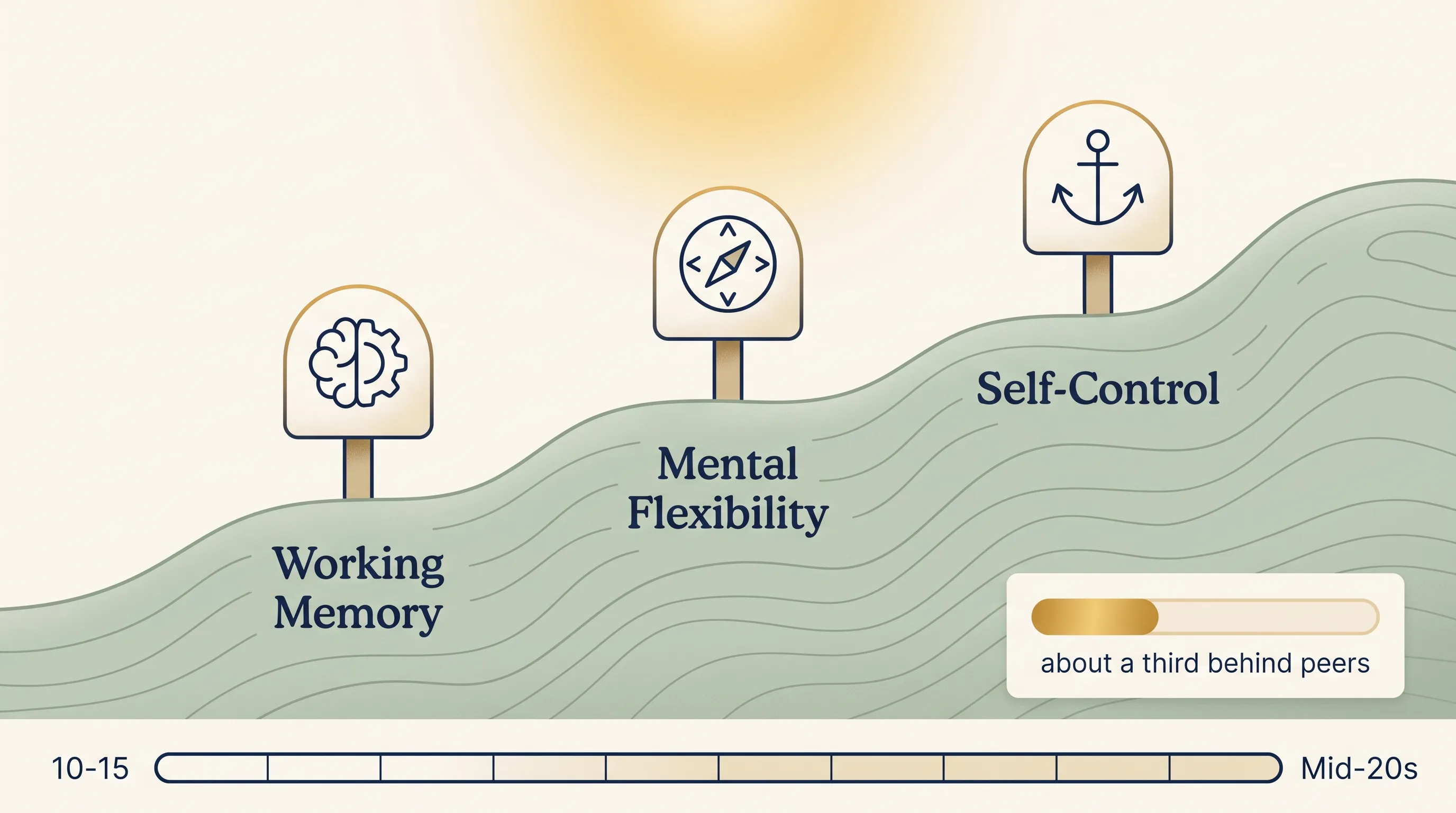
Nearly every "why can't they just do it" struggle traces back to one of three core executive function skills. Harvard's widely cited framework breaks executive function into three building blocks that combine to produce everything else:
- Working memory — holding information in mind and using it, like remembering multi-step directions or keeping a due date in mind while finishing something else first
- Mental (cognitive) flexibility — adjusting to changed rules, unexpected setbacks, or new information without falling apart
- Self-control (inhibitory control) — resisting distraction and impulse long enough to stay on task
From these three, students build the everyday skills parents actually notice: planning, organizing, time management, and task initiation. A student who struggles to start homework isn't lazy — task initiation is a distinct executive function skill, and it can be weak even in students who are otherwise sharp and motivated. Coaching targets these skills directly, one at a time, with real practice in the student's actual life.
Why "Just Try Harder" Doesn't Work: The Adolescent Brain
Telling a teenager to "just be more organized" is asking a brain that isn't finished building the tools to do it with tools it doesn't fully have yet. The prefrontal cortex — the part of the brain most responsible for executive function — doesn't finish maturing until the mid-20s.
Research from Adele Diamond's landmark review in the Annual Review of Psychology shows executive function develops rapidly between ages 10 and 15, then continues maturing well into a person's twenties. That means a 14-year-old and a 24-year-old are working with genuinely different neurological hardware — the teen years are a period of real, uneven, ongoing construction, not a finished product missing effort.
This matters because it reframes the whole conversation. Diamond's research also found that executive function predicts academic and life success at least as reliably as IQ — which means these skills aren't a nice-to-have side note. They're central. And CHADD notes that students with executive function challenges can lag as much as 30% behind same-age peers in this specific area of development — a gap that "try harder" simply cannot close, but explicit, consistent coaching can.

Skills That Go Beyond Homework
Executive function coaching builds skills that outlast the report card. This is where coaching earns its keep long after a semester ends: self-advocacy, emotional regulation, sound decision-making, and independence are all executive function skills at their core — and they're exactly the skills that determine whether a student thrives once the structure of high school disappears.
Self-advocacy means a student can say, "I need an extension" or "I don't understand this — can you explain it differently?" before things spiral. Emotional regulation means a stalled project doesn't turn into a shutdown. Decision-making means weighing options instead of freezing or defaulting to whatever's easiest in the moment. Independence means all of the above happening without a parent standing over a shoulder.
These are precisely the skills that go missing when a student who did fine in a structured high school environment suddenly struggles once that structure is gone — a pattern we cover in depth in why the transition to college trips up so many capable students. Executive function coaching is, in many ways, prevention: building the scaffolding now so it doesn't collapse later, when the stakes are higher and the support is thinner.
Who Benefits Most: Not Just Students With ADHD
Executive function coaching is often associated with ADHD, but the skill set it builds helps a much wider range of students. ADHD does affect executive function significantly, and if that's your student's specific situation, our in-depth guide to ADHD coaching for teens covers that territory closely.
But executive function challenges show up well beyond an ADHD diagnosis:
- Neurotypical students who are bright but disorganized, or who've simply never been taught explicit planning systems
- Anxious students whose worry makes task initiation and decision-making genuinely harder
- Students with learning differences (dyslexia, dysgraphia, processing differences) who need extra scaffolding around planning and self-advocacy
- Autistic students, for whom executive function support often pairs with broader strengths-based strategies — our coaching on the spectrum approach extends this same skill-building model to autistic teens and their families
If your student is missing deadlines, melting down over big projects, or quietly falling behind despite being capable — regardless of diagnosis — executive function coaching is built for exactly that gap.
What Executive Function Coaching Looks Like at Sherpa
Coaching at Sherpa is structured, teen-led, and built around real goals — with parents involved, not sidelined. Sessions follow a consistent rhythm: reviewing what worked and what didn't, identifying the next concrete goal, and building strategies the student actually owns rather than ones handed down from an adult.
This work sits inside Sherpa's broader life coaching and mentoring for teens, which addresses the fuller picture of adolescent development — executive function is often the skill layer underneath a teen's confidence, motivation, and sense of independence.
Parents matter enormously here. Executive function coaching works best when the home environment reinforces what's happening in sessions, and that's where our family counseling and parent coaching services come in — helping parents build structure at home without turning every evening into a negotiation. Ryan Coley, LCSW founded Sherpa Group with this integrated model in mind; you can read more about the team's credentials and approach on our Our Team page.

Executive Function Coaching vs. Tutoring vs. ADHD Coaching
Here's a quick map to orient you. For a full breakdown of ADHD-specific coaching, see our dedicated ADHD coaching guide.
| Executive Function Coaching | Tutoring | ADHD Coaching | |
|---|---|---|---|
| Focus | Broad skill set: planning, organizing, time management, self-advocacy — for any student | Subject-specific content and academic catch-up | Executive function skills specifically shaped around an ADHD diagnosis |
| Best fit | Any student with an execution gap, diagnosis or not | A student behind in a particular subject | A student with a current ADHD diagnosis |
The short version: tutoring closes content gaps, executive function coaching builds the how-to-get-it-done skill set for any student, and ADHD coaching applies that same skill-building lens specifically through an ADHD framework.
Signs Your Student Could Benefit
If several of these sound familiar, executive function coaching is worth a conversation.
- Consistently missed deadlines, even for things they cared about
- Meltdowns or shutdowns when a big project feels overwhelming
- Chronic disorganization — lost papers, forgotten materials, a backpack that's a black hole
- Procrastination that isn't about laziness but about not knowing how to start
- Real struggle with transitions — switching classes, switching tasks, switching from summer to school-year mode
- A pattern of "knows the material but can't show it" on assignments and tests
None of these are a diagnosis, and coaching doesn't diagnose. But they're a clear signal that the skill layer underneath academics needs direct attention.
Finding an Executive Function Coach in Wake Forest or Raleigh
Look for real credentials, adolescent-specific experience, and a clear line between coaching and clinical care. The coaching field is still loosely regulated, so it's worth asking direct questions before you commit.
What to look for:
- Coaching or clinical credentials (like an LCSW-founded practice) rather than a purely academic background
- Specific experience with adolescents — teen executive function looks different from adult executive function
- A structured, goal-based methodology, not vague "study skills" sessions
- Clear parent involvement built into the process
Local vs. virtual is a real decision too. Sherpa Group serves Wake Forest, Raleigh, and the broader Triangle in person, with virtual sessions available across North Carolina for families who need the flexibility.
Frequently Asked Questions
What is the difference between executive function coaching and tutoring?
Tutoring teaches subject content — the actual math, writing, or science skills a student needs. Executive function coaching teaches the process skills that let a student use what they know: planning, starting tasks, managing time, and staying organized. A student who understands the material but can't turn it in on time needs a coach, not more tutoring.
Does my student need an ADHD diagnosis to benefit from executive function coaching?
No. While ADHD significantly affects executive function and often prompts families to seek coaching, plenty of neurotypical, anxious, and learning-different students benefit from the same skill-building approach. If your student does have a current ADHD diagnosis, our ADHD coaching for teens guide goes deeper into that specific path.
Is executive function coaching covered by insurance?
Generally, no. Coaching is not a licensed clinical service, so most insurance plans don't reimburse it. HSA and FSA funds are often eligible — it's worth checking with your plan administrator before ruling it out on cost alone.
What age should executive function coaching start?
There's no single right age, but middle school and early high school are common starting points, since that's when independent planning demands increase sharply. Coaching can also help older teens and young adults who are heading into or already navigating college.
How is executive function coaching different from ADHD coaching?
Executive function coaching is the broader category — it builds planning, organizing, and self-management skills for any student who needs them. ADHD coaching applies that same skill set but is shaped specifically around the patterns and challenges of an ADHD diagnosis. Every ADHD coach does executive function work; not every executive function coach specializes in ADHD.
The Next Right Step
Executive function isn't a character trait — it's a skill set, and skill sets can be built. Whether your student is neurotypical and simply never learned a planning system, navigating anxiety, working with a learning difference, or managing ADHD, the path forward looks similar: explicit teaching, real practice, and a guide who knows the terrain.
Executive function coaching complements, not replaces, any clinical care your student may already have in place — it works alongside therapists, doctors, and school teams rather than instead of them.
If you're watching a capable student struggle to keep up with their own potential, a conversation is a good first step. Reach out to Sherpa Group today — we'll help you figure out whether coaching is the right fit, and what starting point makes sense for your family.