

Your teen just got an ADHD diagnosis — or maybe they've had one for years and things still aren't clicking at school. You've tried tutoring. You've read the books. You're wondering if there's something that actually builds the skills underneath the struggle.
ADHD coaching for teens does exactly that. It's not more academic help. It's not therapy. It's a structured, forward-looking partnership that teaches the executive-function skills ADHD makes genuinely hard: getting started, staying organized, managing time, and advocating for yourself.
This guide explains what coaching is, how it differs from tutoring and therapy, what a real session looks like, and how to find the right fit in the Raleigh area.
Most Parents Name the Problem Wrong
Parents usually try tutoring first — and it makes sense. Grades are slipping; tutoring fixes grades. Except it often doesn't, not for long, and not for teens with ADHD.
That's because tutoring addresses content (what your teen knows), therapy addresses emotions (anxiety, depression, and the weight of years of struggle), and coaching addresses execution (how your teen actually does things). For an ADHD brain, the gap is almost always in execution.
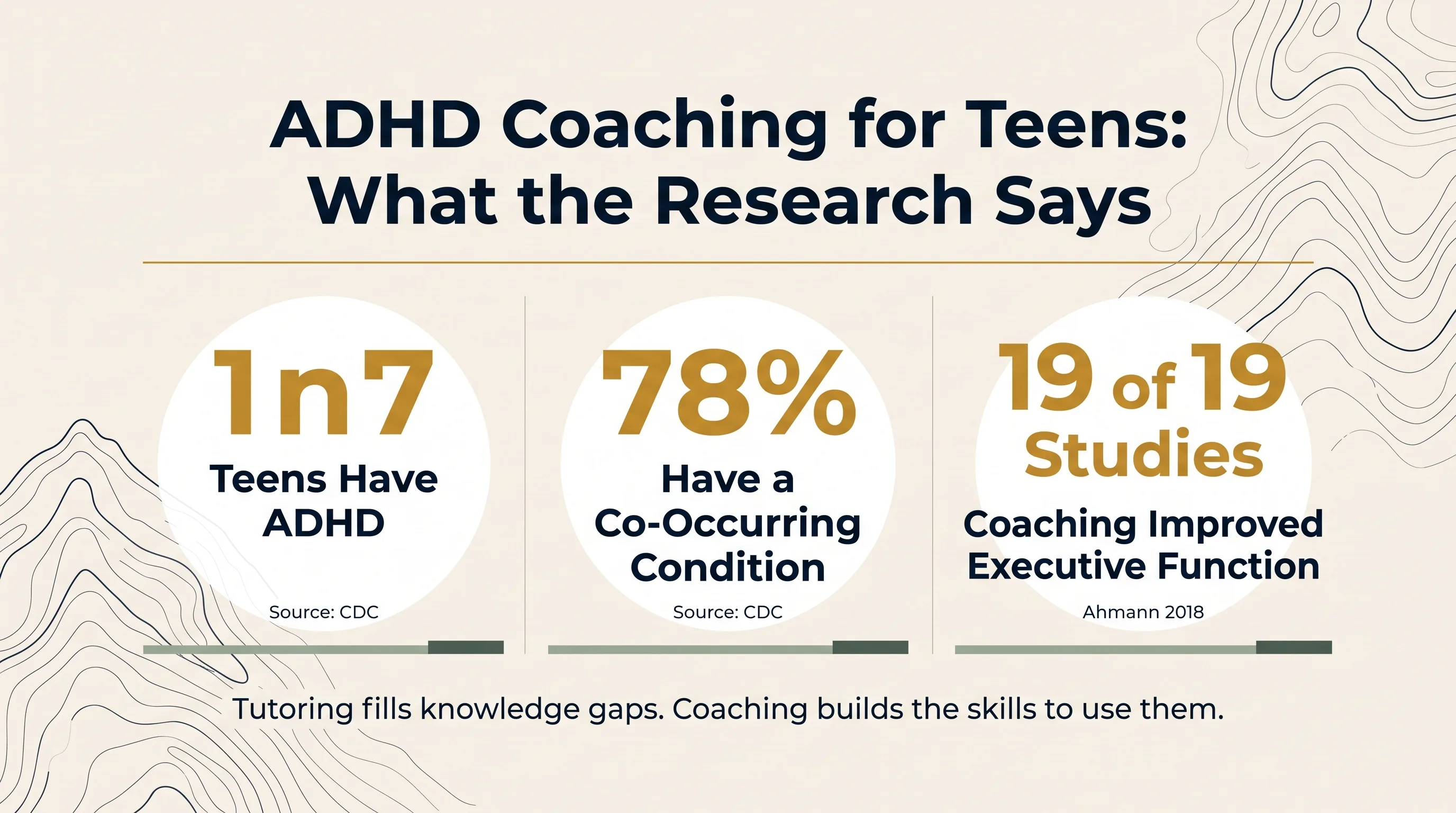
According to CDC NCHS Data Brief 499 (2024), 14.3% of U.S. teens ages 12–17 have a current ADHD diagnosis — and CDC data shows 78% of them have at least one co-occurring condition, most often anxiety or a learning difference. That means most teens with ADHD aren't just disorganized. They're carrying a real cognitive load. Tutoring more content onto that load rarely solves the underlying problem.

What ADHD Coaching for Teens Really Is
ADHD coaching is a skills-building, goal-focused partnership. It is not diagnosis, assessment, or treatment. A teen needs a diagnosis from a licensed clinician before coaching begins — coaching works best once the "what" is clear and the family wants to build the "how."
CHADD describes ADHD coaching as a structured process that helps clients identify goals, develop strategies, and build accountability — all framed around the person's strengths rather than their deficits.
At Sherpa Group, that work is led by Peyton Risley Davis, M.Ed., CALC — a Certified ADHD Life Coach and Master IEP Coach with deep experience in adolescent executive function. She works inside a practice founded by Ryan Coley, LCSW, which means her coaching exists within a clinical framework, not apart from it. You can read more about the team on our Our Team page.
Coaching does not treat, cure, or manage ADHD as a clinical condition. It builds the skills and habits that help a teen function better day to day — and it works best alongside, not instead of, clinical care.
The 6 Executive-Function Skills Coaching Builds
Executive function (EF) is the brain's management system: planning, starting, organizing, regulating, and following through. Research published in Psychological Science in the Public Interest (Diamond, 2013) — drawing on 179 studies — found that EF predicts academic success more reliably than IQ. For teens with ADHD, these skills are the real leverage point.
These same skills matter for students without an ADHD diagnosis too — if you're weighing support more broadly, our guide to executive functioning coaching for students covers the wider picture.
Coaching systematically targets six core areas:
- Time management / time blindness — helping teens feel, track, and plan time rather than just react to it
- Task initiation — building strategies for starting hard or boring tasks without a last-minute crisis
- Planning and prioritization — breaking big goals into steps and deciding what matters first
- Organization — physical and digital systems that fit how the teen's brain actually works
- Emotional regulation — managing frustration and disappointment without derailing the whole day
- Self-advocacy — knowing what accommodations the teen needs and how to ask for them
All 19 studies reviewed by Ahmann et al. (2018) showed improved ADHD symptoms or EF outcomes after coaching — a consistent signal, even if the adolescent-specific evidence base is still thinner than what exists for college students and adults.
ADHD Coaching vs. Tutoring vs. Therapy: A Clear Map for Parents
This is the question parents ask most. Here's a direct comparison.
| ADHD Coaching | Tutoring | Therapy | |
|---|---|---|---|
| What it solves | Executive-function gaps; skill and habit development | Content and academic knowledge gaps | Emotional health; anxiety, depression, trauma, co-occurring conditions |
| What a session looks like | Teen-led goal review, strategy building, accountability; forward-focused | Reviewing subject material, homework help, test prep | Processing experiences, emotions, and patterns; may involve CBT, DBT, or other modalities |
| Best when | Teen has ADHD diagnosis; EF gaps affect daily life; family wants sustainable strategies | Teen is behind in a subject; needs academic catch-up | Teen has anxiety, depression, or another co-occurring condition; needs clinical support |
| Credentials | CALC, PAAC, or similar ADHD certification; coaching training | Subject expertise; often a teaching background | Licensed clinician: LCSW, LPC, psychologist |
| Insurance | Generally not covered; HSA/FSA often eligible | Generally not covered | Often covered; varies by plan |
Important note: if your teen has anxiety, depression, or another co-occurring condition, a licensed clinician should be involved. Coaching and clinical care work well together — they address different layers of the same challenge. Ryan Coley, LCSW built Sherpa precisely so families don't have to choose.
What a Typical Coaching Session Looks Like
ADHD coaching is teen-led and forward-focused. Sessions typically run 45–60 minutes, one to two times per week, with brief between-session check-ins to maintain momentum.
The first session focuses on understanding the teen's unique EF profile and co-building a goal map. From there, each session follows a consistent rhythm: what did we work on, what worked, what's coming up, what's the plan?
Most families notice shifts in 4–6 weeks. Real habit change — the kind that sticks without constant reminders — tends to develop over three to six months. A 2026 study published in JAMA Network Open (Sibley et al.) found a median coaching duration of 24 weeks in its sample, which aligns with what most families experience: this isn't a quick fix, but it's also not indefinite.
Sessions are held virtually, which means the coaching can fit your teen's actual life — no commute, no scheduling gymnastics.
ADHD Parent Coaching: Why the Teen Can't Do It Alone
The research is clear: parental involvement significantly amplifies coaching outcomes for adolescents. But "involvement" doesn't mean hovering — it means the parent learns a different way to engage.
ADHD parent coaching treats the parent as the client. Sessions help you build structure without battles, communicate in ways your teen can actually hear, and stop the nightly homework war before it starts.
Peyton is also a Master IEP Coach. That means she can help families understand, navigate, and advocate within their teen's IEP or 504 plan — not as legal advice, but as informed educational advocacy from someone who knows how these systems work. If you've ever left an IEP meeting feeling confused or outnumbered, this matters.
Parent coaching at Sherpa connects directly to our family counseling and parent coaching services, which gives families a full picture of support — coaching and clinical guidance under the same roof.
If your teen is also navigating neurodivergence beyond ADHD, Sherpa's coaching on the spectrum extends the same EF-focused, strengths-based approach to autistic teens and those with co-occurring diagnoses.
Is ADHD Coaching Covered by Insurance?
Honest answer: usually not. Coaching is not a licensed clinical service, so most health insurance plans do not reimburse it.
What often does work:
- HSA and FSA funds — many health savings and flexible spending accounts cover coaching services when tied to a diagnosed condition; check with your plan administrator
- Out-of-pocket planning — the 2026 JAMA Network Open study found a national median of approximately $150 per session
The ROI framing that resonates with most families: if coaching reduces years of remedial academic support, conflict at home, and the downstream cost of a teen who never built self-management skills, the math often looks different than it does per-session. That said, we believe in honest conversations about fit and cost — no family should stretch beyond their means without full information.
Finding an ADHD Coach in Raleigh or Wake Forest
The ADHD coaching field is still relatively unregulated, which means the quality gap between practitioners is significant. Here's what to look for.
Look for:
- Recognized ADHD coaching certification: CALC (Certified ADHD Life Coach), PAAC (Professional Association of ADHD Coaches accreditation), or ACO credentials
- Specific adolescent experience — adult coaching and teen coaching require very different approaches
- IEP/504 familiarity if your teen has an active plan
- Clear distinction between coaching and therapy
Red flags:
- Tutors billing themselves as ADHD coaches with no coaching certification
- Claims to treat or cure ADHD
- No defined coaching methodology or structure
Sherpa Group serves Wake Forest, Raleigh, and the surrounding Triangle area, with virtual sessions available across North Carolina. Peyton Risley Davis holds her CALC certification and Master IEP Coach credential. The practice is founded and clinically grounded by Ryan Coley, LCSW — which means coaching here isn't operating in a vacuum, it's embedded in real clinical expertise.
For teens navigating the full range of life coaching needs, our life coaching and mentoring for teens provides a broader picture of how Sherpa supports adolescent development.
Frequently Asked Questions
What's the difference between ADHD coaching and therapy?
Therapy, provided by a licensed clinician, addresses emotional health — anxiety, depression, trauma, and co-occurring conditions. ADHD coaching builds executive-function skills: time management, task initiation, organization, and self-advocacy. Many teens benefit from both, since 78% of teens with ADHD have at least one co-occurring condition. At Sherpa, the two can happen within the same practice.
Is ADHD coaching covered by insurance?
Most health insurance plans do not cover ADHD coaching, since it is not a licensed clinical service. HSA and FSA accounts are often eligible — check with your plan administrator. The national median cost is approximately $150 per session (JAMA Network Open, 2026).
How is ADHD coaching different from tutoring?
Tutoring addresses content — what your teen knows in a subject. Coaching addresses execution — how your teen plans, starts, and follows through on tasks. A teen who needs to learn algebra needs a tutor. A teen who understands the material but can't start the homework or turn it in on time likely needs a coach.
How do I know if my teen is ready for ADHD coaching?
Your teen is likely ready if they have a current ADHD diagnosis, their struggles are showing up in daily executive function (not just in one subject), and they have some willingness to work on strategies — even reluctant willingness. Motivation doesn't have to be high at the start; a good coach knows how to build buy-in. A brief consultation can help clarify whether coaching, parent coaching, or a different starting point makes the most sense.
What does an ADHD coach actually do in a session?
In a typical session, the coach and teen review the past week — what worked, what didn't, and why. Then they build a concrete plan for the week ahead: specific strategies, tools, and check-in points. Sessions are forward-focused and solution-oriented, not focused on processing the past. The coach asks questions and reflects patterns back; the teen does the deciding. Over time, those decisions start happening without the coach in the room.
The Right Guide for This Climb
ADHD coaching for teens is not a magic fix, and any coach worth trusting will tell you that. It's a structured, skills-building process that takes time, consistency, and a teen who's willing to try — even if "willing" starts at about 40%.
What makes Sherpa's approach different: Peyton Risley Davis brings CALC certification, Master IEP Coach credentials, and genuine adolescent expertise. Ryan Coley, LCSW founded the practice, which means coaching here lives inside a clinical framework. Parent coaching is built in, not bolted on. And the IEP/504 navigation piece — so often the missing link for families — is part of what Sherpa does every week.
ADHD coaching at Sherpa complements, not replaces, your family's clinical team. We work best as one piece of a thoughtful support plan.
If you've been wondering whether coaching might be the missing piece for your teen, a conversation costs nothing. Reach out to Sherpa Group today — we'll help you figure out whether coaching is the right fit, and what the first step looks like for your family.