

You know something in the business needs to change. What is less clear is who could help you change it.
Maybe growth has made your old systems harder to manage. Maybe your team has a plan, but conversations keep circling back to the same unresolved decisions. You would welcome some support. You would also like to understand what you are actually hiring someone to do.
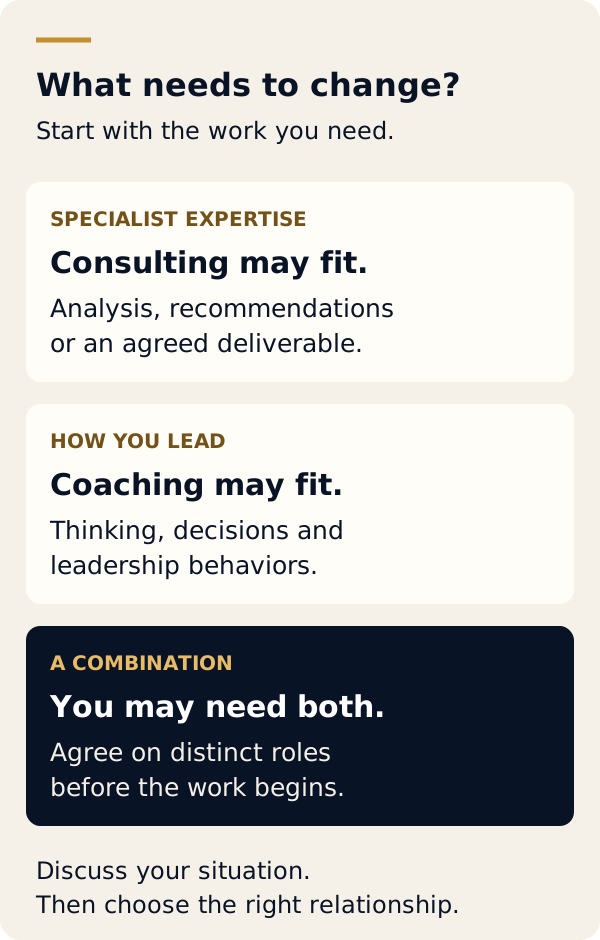
The distinction between business coaching and consulting comes down to the work you need help with. Consulting often brings specialist expertise to a business problem, with agreed advice or deliverables. Coaching focuses on developing your thinking, choices, and ways of leading. The two can overlap, and neither label tells you everything about an engagement.
You do not have to know which one to choose before having a conversation. It helps to begin with what you want to be different when the work is done.
Business coaching vs consulting at a glance
The most useful comparison is the contribution you want someone to make. Both relationships require your involvement; neither removes your responsibility for the business.
Swipe the table to compare both types of support.
| What you want help with | Coaching may fit when… | Consulting may fit when… |
|---|---|---|
| Understanding a challenge | You want to examine how you are interpreting and responding to it. | You need specialist analysis of a process, market, or technical question. |
| Deciding what to do | You want to strengthen your judgment and work through competing priorities. | You need an informed recommendation grounded in expertise you do not have. |
| Making change happen | You want to practice different leadership behaviors and review what happens. | You need an agreed plan, design, or implementation contribution. |
| Defining the work | The focus is your development and its application in the business. | The scope centers on an agreed business problem and deliverables. |
These are starting points, not fixed boundaries. A consultant may build your team's capability as part of a project. A coach may offer an observation that challenges your thinking. What matters is whether the proposed work matches what you need.
When expertise is the missing piece
Consulting can be a good fit when the business needs knowledge or capacity that your team does not currently have.
The Cyprus Institute of Certified Management Consultants describes management consulting in terms of independent advice and assistance with organizational problems and improvements. That broad definition covers different kinds of work, which makes the specific agreement important.
Imagine, for example, that you are opening another location. You need someone to examine your inventory process, compare software options, and recommend a system that fits your operation. That calls for relevant expertise and clearly defined work. A thoughtful conversation about your leadership would not replace the analysis.
A consulting agreement could include assessing the current process, recommending changes, training the team, or supporting implementation. Those are possible scopes, not services every consultant provides. Someone who delivers a report may have a very different role from someone who stays through the rollout.
Good consulting still requires a working relationship. You provide access, explain constraints, question assumptions, and make decisions. The consultant needs to understand your business well enough for the advice to be useful there.
The question is less “Can someone tell me what to do?” and more “Whose expertise would help us make this decision well, and what work are we asking them to complete?”
When your way of leading needs room to grow
Coaching may fit when the challenge involves how you think, communicate, decide, or carry responsibility as a leader.
You may already understand the available options. The difficult part is choosing between them, discussing the decision honestly, or following through when the conversation gets uncomfortable.
The International Coaching Federation describes professional coaching as a partnership that supports clients in exploring their potential. In practice, that means you bring the context and remain responsible for your choices. ICF's explanation of coaching offers a useful foundation for understanding that relationship.
Consider a hypothetical owner whose leadership team has agreed on a direction, yet leaves every meeting with decisions still open. Coaching could help the owner examine what happens in those conversations: whose concerns remain unspoken, where expectations are unclear, and how their own responses affect the discussion.
The aim is to turn that understanding into something the owner can try differently. A conversation is valuable when it changes what becomes possible in the work that follows.
Sherpa's executive and business coaching provides space for that kind of work with individual leaders and leadership teams. You can bring a situation that feels messy or difficult to explain; you do not need to arrive with a neatly packaged leadership problem.

Sometimes the business needs both
A business problem can have an operational side and a leadership side. Addressing one does not automatically resolve the other.
Return to the hypothetical new location. A consultant might recommend an inventory system and help introduce it. Meanwhile, the owner may keep overriding the manager's decisions because stepping back feels risky.
The system could be appropriate, and the owner could still benefit from coaching around trust, expectations, and responsibility. Coaching could support that leadership work while the consultant addresses the operational work.
The same distinction applies when you are learning to delegate as a business owner. A written process may be useful. So may a closer look at what happens when someone uses it without involving you in every decision.
There is no need to purchase two services automatically. Start with the difficulty that is preventing progress now. Ask whether resolving it requires specialist work, a change in leadership, or a combination. If several people are involved, agree on their responsibilities so you are not paying for overlapping work or receiving conflicting direction.
Ask what the relationship will actually involve
A clear agreement matters more than a confident label. Before choosing a coach or consultant, talk through a real situation and listen to how they would approach it.
You might say, “Our managers keep bringing decisions back to me. What would you work on with us, and what would remain our responsibility?” A useful answer should make the proposed work easier to picture.
Discuss what you would leave with, who would participate, and how you would recognize progress. If a consultant is recommending a new process, clarify whether implementation is included. If you are considering coaching, discuss how the conversations will connect to the leadership changes you want to make.
Some professionals work in more than one role. That can be helpful when the roles are explicit. You should know whether you are exploring your own thinking, receiving a specialist recommendation, or agreeing on work someone will deliver.
The ICF Code of Ethics is a useful professional reference for clear coaching agreements, including roles, responsibilities, confidentiality, and financial arrangements. Ask how those subjects apply to your engagement, especially if your company is paying for someone else's coaching.
It is also reasonable to discuss fees, timing, and the work expected between meetings. A proposal should give you enough clarity to decide whether the commitment fits your situation. You do not need to accept a vague promise of transformation in place of that conversation.
Questions about business coaching vs consulting
Is a business coach the same as a consultant?
No, although one person may offer both services. Coaching generally centers on developing your thinking and leadership; consulting generally brings expertise to an agreed business problem. Ask about the actual role, scope, and expected work rather than relying on the title alone.
Can a business coach give advice?
Some coaching relationships include observations or advice, depending on the professional and the agreement. That does not make every coach a qualified specialist in your particular business issue. Clarify when someone is offering expertise and when they are helping you develop your own answer.
Should I hire a coach or consultant first?
Start with the work that is most needed now. A specialist analysis or implementation project may call for a consultant. A recurring leadership pattern may call for coaching. If you are unsure, describe the situation and ask each professional to explain where they can help and where another kind of support would be appropriate.
How do I know whether coaching is helping?
Agree on changes you can observe in your leadership, such as making decisions more clearly or addressing difficult conversations you have avoided. Review those changes alongside the business outcomes you care about, without assuming coaching alone caused them. Our guide to what to expect from executive coaching explains how that conversation can begin.
Is coaching or consulting more expensive?
The label alone will not tell you. Compare the proposed scope, expertise, time, deliverables, and support included in each offer. Sherpa's executive coaching pricing is tailored to the depth and scope of the engagement; Ryan can discuss a quote during the consultation.
Start with the situation, not the perfect label
You do not need to decide that you are “the kind of leader who needs coaching.” You can simply notice that something matters enough to give it more attention—and that working through it with someone could help.
Ryan Coley brings experience as an executive coach and multi-unit franchise owner, alongside his background as a Licensed Clinical Social Worker. At Sherpa, the conversation starts with you, your business, and what you would like to change.
If you are wondering whether coaching fits, start with a free, no-obligation consultation. Bring the situation you are facing and the questions you still have. There is room to work out the next step together.