

You hired good people. You want them to take ownership. So why are you still reviewing the email, adjusting the schedule, and answering questions you thought someone else could handle?
Learning how to delegate as a business owner can feel uncomfortable when your name, reputation, and business are attached to the result. You may have built the company by noticing what others missed. Being involved helped you get here.
Now that same involvement might be filling your day with work you hoped to hand over.
There is a way to give people more room while keeping expectations clear. It starts with looking closely at what you are asking them to own—and what you are still keeping for yourself.
Why letting go can feel so personal
Delegation asks you to tolerate a different way of doing work you care about.
Perhaps you remember a customer being disappointed after you stepped back. Perhaps it really would take you ten minutes to do something that takes a newer manager an hour. Perhaps being the person with the answer has become a familiar part of your day.
Those are understandable reasons to stay involved. They are also worth examining.
When you reach for a task someone else owns, pause long enough to ask: What am I concerned will happen if I leave this with them?
A specific concern gives you something useful to address. An inexperienced employee may need training. An unclear deadline needs clarification. A customer commitment may need your attention.
But sometimes the concern is simply that the person will do it differently. Recognizing that distinction gives you more choices than stepping in every time you feel uneasy.
Give the responsibility a clear owner
A person needs to know which decisions are theirs before you can reasonably expect them to act independently.
“Please handle this” can mean several things. Research it and bring back options? Make a recommendation? Decide and tell me afterward? Complete it without involving me?
If you mean the last one but respond as though you meant the first, your employee has a good reason to keep checking.
The Center for Creative Leadership's guidance on effective delegation emphasizes giving people authority alongside responsibility, with the support and resources to carry out the work.
Before your next handoff, try answering one plain question together: What can this person decide without asking me?
You do not need a complicated document. You need a shared answer, especially where the work touches customers, money, or other team members.

Let the standard be clear enough to travel without you
Your team can work toward a standard they understand. They cannot reliably work toward an expectation that exists only in your head.
Consider this illustrative situation: a business owner asks a manager to prepare next week's staffing schedule. The manager completes it. The owner then changes several shifts because the arrangement feels wrong.
Was the schedule understaffed during a busy period? Did it miss an availability request? Or did the manager make a reasonable choice the owner would not have made?
Those are different conversations.
A clearer handoff might sound like this:
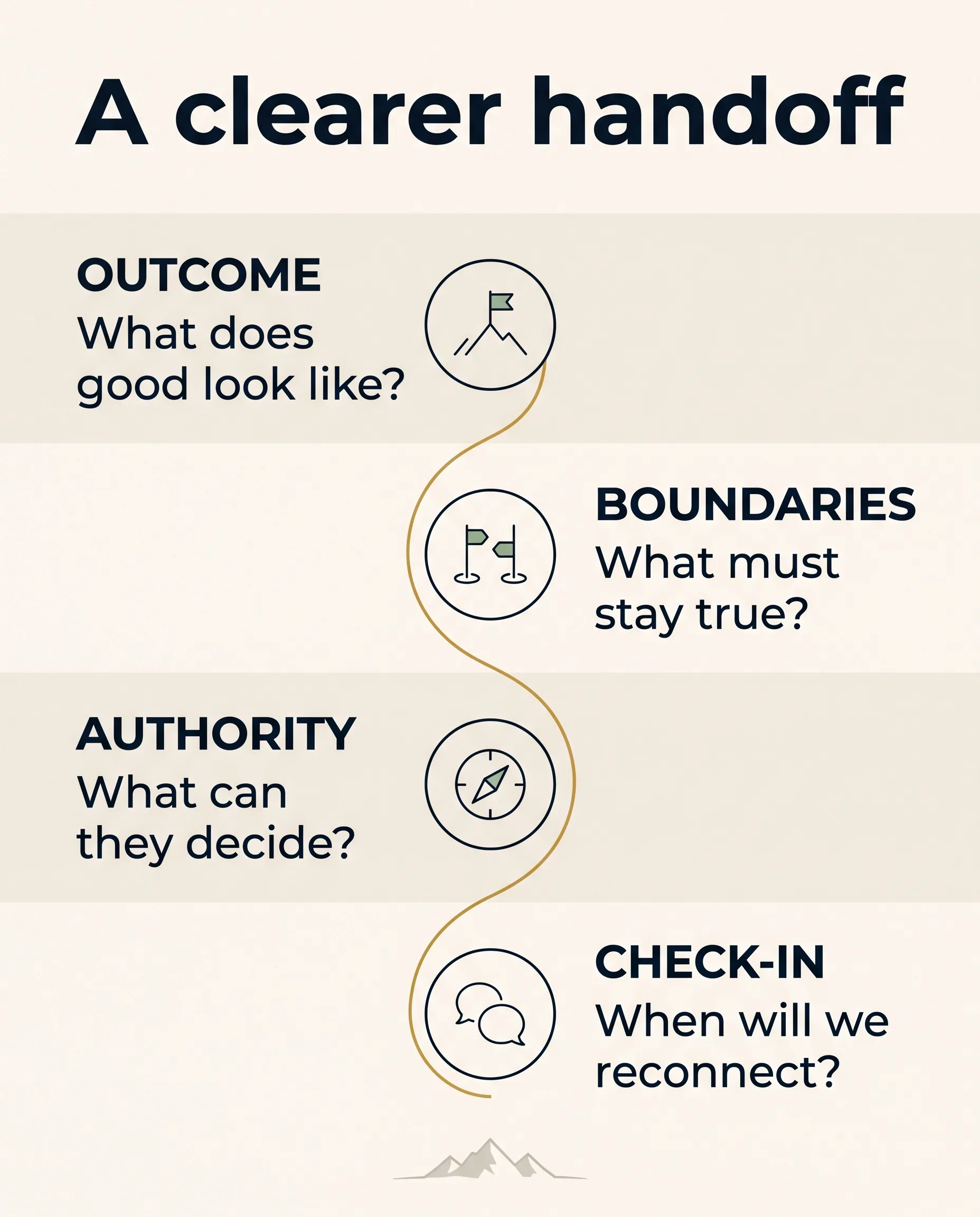
“Please have next week's schedule ready by Thursday. Cover our expected busy periods, use the approved staffing budget, and account for the availability requests. You can make the shift assignments. Bring me any gap you can't resolve within those boundaries, and we'll look at the first draft together on Wednesday.”
The manager now knows the result, the boundaries, the authority, and when help is available. There is enough clarity to get started without asking the owner to make every choice.
Your own situation may involve a client proposal, a supplier decision, or a recurring team meeting. The question is the same: have you explained what matters well enough for someone else to make a sound choice?
Keep your preferences separate from the requirements
High standards become easier to uphold when you can explain why they matter.
A proposal that promises work your team cannot deliver needs correction. A proposal arranged differently from yours may still serve the customer well.
Before changing someone's work, ask yourself:
- Does this miss an agreed requirement?
- Does it create a problem the person has not considered?
- Or would I simply have done it another way?
If there is a real issue, name it. “This timeline doesn't include installation” gives someone a clear problem to solve. Quietly rewriting the proposal leaves them with less understanding of what happened.
Harvard Business School Online's advice on delegating effectively similarly encourages managers to communicate the desired outcome while allowing employees room to choose their approach.
You can share your experience without making your method the only acceptable one. That room is where another person gets to exercise judgment.
Stay available without becoming the extra approval step
Useful support has a purpose both of you understand.
Agree on check-ins before the work begins, with timing that fits the person's experience and the consequences of a mistake. Someone handling a familiar responsibility may need little contact. Someone learning something consequential may need closer support.
During the conversation, stay curious about their thinking. “What are you seeing?” and “What do you recommend?” invite a fuller answer than another status report.
You might discover a barrier you can remove. You might hear a sound plan that needs no adjustment. You might need to explain something you assumed they already knew.
What matters is leaving the conversation clear about who owns the next move. If you routinely finish by taking over, it is worth asking whether the check-in is helping someone develop or simply returning the work to you.
When delegation goes badly, examine the handoff
A disappointing result deserves attention. It also deserves a more specific explanation than “delegation doesn't work.”
Look at what happened before deciding what it means. Was the outcome clear? Did the person have enough time, information, and experience? Did they know when to bring a concern forward? Did you change an expectation halfway through?
Sometimes the person needs more practice or a smaller responsibility. Sometimes performance needs a direct conversation. Sometimes the assignment was unrealistic alongside everything else on their plate.
You can address the immediate problem and still learn from it. If you do need to take over, explain why and discuss what happens next. Otherwise a temporary intervention can quietly become the permanent arrangement.
Begin with one responsibility you can genuinely release
A manageable starting point gives both of you room to learn.
Choose a recurring responsibility that someone can realistically handle with appropriate support. Avoid handing over your most consequential decision simply to prove you are serious about delegation.
Then pay attention to your side of the agreement. Are you checking in when you said you would? Are you allowing the decisions you agreed were theirs? Are you recognizing progress as well as correcting errors?
For an owner, this can be a meaningful change in how leadership feels. Your contribution may become less visible in each individual task while remaining essential in the direction, expectations, and support you provide.
That adjustment is a useful subject for executive and business coaching. A conversation can help you look at the specific situations where you step in, the choices available to you, and what you want to practice differently.
Questions business owners ask about delegation
How do I stop micromanaging without losing control?
Make the important expectations explicit: the outcome, boundaries, decision authority, and check-in points. Start with a responsibility suited to the person's readiness. You can retain oversight of the result while allowing meaningful room in how the work gets done.
What is the difference between accountability and micromanagement?
Accountability involves clear commitments and a fair conversation about whether they were met. Micromanagement can involve repeatedly controlling details or requiring approval where someone was meant to have discretion. The distinction depends on the task, risk, experience, and agreement—not simply how often you talk.
What if it really is faster to do it myself?
It may be faster today, especially if someone is learning. Consider whether the responsibility will recur and whether teaching it is a worthwhile investment. There will also be situations where doing it yourself is appropriate. Make that choice deliberately rather than treating today's speed as the only measure.
What if my team keeps bringing every decision back to me?
Ask what makes the decision hard to take independently. They may need information, clearer authority, more experience, or reassurance that an agreed decision will not be unexpectedly reversed. Examine how you respond when someone does act without asking; that response may help explain the pattern.
Can executive coaching help with delegation?
Delegation can be a useful focus for executive coaching when you want to examine leadership habits, communication, and responsibility. It does not replace job-specific training or a direct performance conversation. Sherpa's guide to what to expect from executive coaching explains how that work can begin.
Give yourself room to lead
You do not have to become a different person overnight. Start with one responsibility, a clearer agreement, and a willingness to notice when you are about to take it back.
You can care deeply about the work and help someone else become more capable of carrying it.
If this feels familiar in your business, Ryan Coley brings experience as an executive coach and multi-unit franchise owner, alongside his background as a Licensed Clinical Social Worker. His coaching addresses the people and relationships involved in leadership.
You are welcome to start with a free, no-obligation consultation. Bring the situation you keep returning to. You and Ryan can talk about what is happening, what you would like to change, and whether working together feels like a good fit.