

If you've searched "what is parent coaching," chances are something at home feels harder than it should. Maybe bedtime turns into a nightly standoff. Maybe you and your co-parent can't agree on the rules, and your kids have figured out how to work that gap. Maybe your teen is pulling away, and every conversation ends in a slammed door. Your family isn't broken. You just need a clearer set of tools, and someone who's walked this trail before to help you use them.
Parent coaching is a structured, goal-driven partnership that helps parents build the specific skills their family needs right now, without diagnosing anyone or treating a condition. This guide breaks down what parent coaching actually looks like, how it's different from family therapy, and how to know if it's the right next step for your family in Wake Forest or Raleigh.

What Parent Coaching Actually Is
Parent coaching is a present-focused, skills-based partnership, not a diagnosis and not a form of treatment.
A parent coach works with you on the specific behaviors, routines, and communication patterns causing friction in your home today. Instead of digging into the "why" behind a lifetime of patterns, coaching stays anchored in the here and now: what's happening, what you want instead, and what you can practice this week to move toward it.
Good parent coaching services rest on a few things:
- Clear goals you set together, revisited as your family changes
- Practical strategies for communication, boundaries, and consistency
- Accountability between sessions, so ideas turn into habits
- A partnership, not a lecture. You know your kids. A coach helps you use what you know more effectively.
Parent coaching effectiveness has research behind it. A peer-reviewed meta-analysis of 63 studies found that structured parent-training approaches like this produce real, measurable gains in three places at once: children's behavior, parents' own skills, and parents' confidence in how they parent, according to Lundahl, Risser & Ford's meta-analysis of parent training programs. In plain terms: when parents get structured support and practice new skills, both the child's behavior and the parent's confidence tend to improve.
How a Parent Coaching Session Works
A parent coaching session is a working conversation, not just talk about what's wrong. You leave with something concrete to try.
Here's roughly what a session looks like:
- Check-in. What happened since last time? What worked, what didn't?
- Focus. You and your coach pick one or two situations to work on, not everything at once.
- Strategy. Your coach offers specific language, structure, or a plan tailored to your family and your kids' ages.
- Practice and plan. You leave knowing exactly what to try before the next session.
Sessions are typically weekly or biweekly and build on each other. There's no clinical file, no waiting for insight to surface on its own. It's closer to working with a coach before a hard climb: you show up, you get a next step, and you go practice it in real life with your kids.
Parent Coaching vs. Family Therapy: What's the Difference?
Parent coaching addresses everyday friction in an otherwise healthy family. Family therapy addresses diagnosable mental illness, trauma, or clinical risk. Many families benefit from both, at different times or even at once.
Coaching is the right fit when the family system is fundamentally sound and the challenge is behavioral or logistical: inconsistent routines, communication breakdowns, sibling conflict, co-parenting misalignment after a divorce, or a teen pushing for more independence than the current rules allow.
Therapy is the right fit when there's a diagnosable condition, unresolved trauma, or a safety concern involved. Parent coaching does not diagnose or treat mental illness, and it isn't a substitute for clinical care when a child or parent needs it. A licensed therapist is the right next step in those cases.
This is where Ryan Coley's background matters. As a Licensed Clinical Social Worker (LCSW) as well as a coach, Ryan and the Sherpa team are trained to recognize when a family's needs go beyond coaching, and to refer out to the right clinical support when that's the case. You don't have to self-diagnose which lane you're in before you reach out.
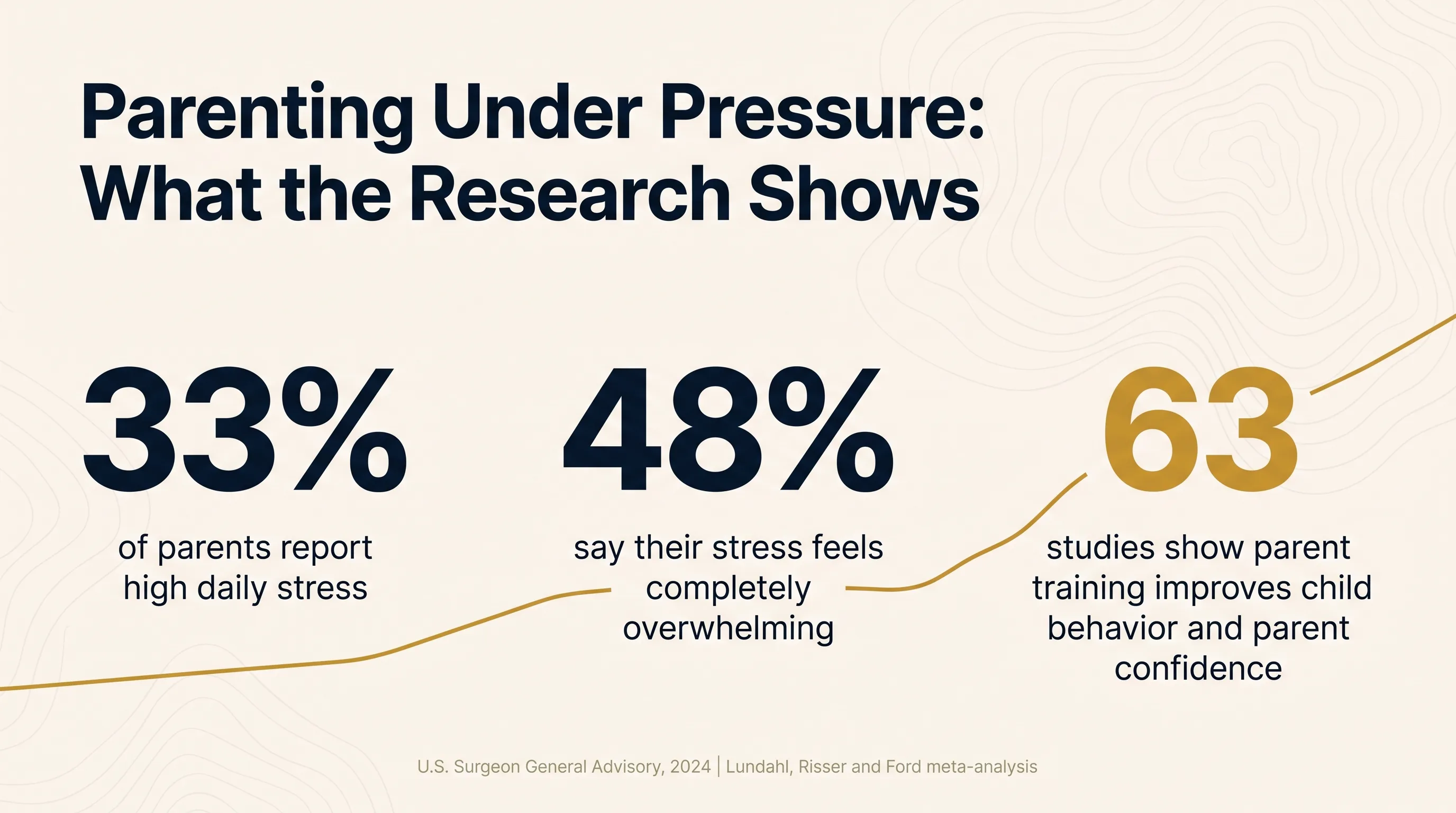
The demand for this kind of support is real. According to the U.S. Surgeon General's 2024 advisory on parental stress, 33% of parents report high stress, and 48% describe their stress as "completely overwhelming" on most days. Coaching won't erase every hard day, but it gives parents a framework for the ones that keep repeating.
For families ready to go deeper, Sherpa's full family counseling and parent coaching program lays out the complete process, from first conversation through what to expect session by session.
Signs Parent Coaching Might Be Right for Your Family
If the same conflict keeps repeating and your child is safe and healthy, parent coaching is likely a strong fit.
Common signs include:
- The same argument happens night after night, with no real resolution
- Discipline is inconsistent: one parent enforces a rule the other lets slide
- Co-parenting friction after separation or divorce is spilling onto the kids
- Your teen wants more independence than feels safe to grant, and every conversation about it turns into a fight
- You're reactive more often than you'd like, and you know it
What these signs have in common: your child isn't in crisis, and your family isn't in danger. You're just stuck in patterns that aren't working, and you want a better way through. That's exactly the territory a parenting coach is built for.
If you're not sure how much structure you need yet, Sherpa's lighter-touch parent and family coaching track is a low-commitment way to start.

What Parent Coaching Can Help With
Parent coaching covers the everyday friction points that wear families down over time.
- Communication breakdowns. Conversations that used to be easy now end in shutdowns or shouting.
- Co-parenting alignment. Getting two households on the same page about rules, routines, and consequences.
- Boundaries and consistency. Setting limits that actually hold, and following through without constant renegotiation.
- Teen independence. Helping teens earn more autonomy while parents stay confident, not anxious, about letting go. Sherpa's teen life coaching and mentoring program works alongside parent coaching when a teen needs their own support for this stage.
Why Wake Forest & Raleigh Families Are Turning to Parent Coaching
Local demand for parent coaching in Raleigh and Wake Forest has grown alongside a broader national trend of parents seeking real, practical support.
Families here are juggling long commutes, dual careers, blended households, and kids growing up faster than most of us expected. What's changed isn't that parenting got harder overnight, it's that more parents are willing to ask for help before things reach a breaking point. That's a strength, not a weakness.
Working with a local parenting coach means working with someone who understands this community: the school calendars, the youth sports schedules, the particular pressures of raising kids in the Triangle. Sherpa Group is led by Ryan Coley, LCSW, a licensed clinician and business coach who has worked with Wake Forest and Raleigh families since 2015. That local, licensed perspective is part of what sets Sherpa's parent coaching services apart from a generalist coaching program.
Frequently Asked Questions
What is parent coaching, exactly?
Parent coaching is a structured, goal-driven partnership that helps parents build specific communication, boundary-setting, and consistency skills. It's forward-looking and practical: you leave sessions with strategies to try, not just insight into what's wrong.
Is parent coaching the same as therapy?
No. Parent coaching does not diagnose or treat mental illness. It's a good fit for everyday behavioral and communication challenges in an otherwise healthy family. If there's trauma, a diagnosable condition, or a safety concern, a licensed therapist is the right next step, and it's common for families to use coaching and therapy at the same time.
What does a co-parenting coach do?
A co-parenting coach helps two households get aligned on rules, routines, and communication, especially after a separation or divorce. The goal is consistency for the kids: the same expectations and consequences no matter which house they're in, and less conflict passing through them in the process.
How much does parent coaching cost, and how long does it take?
Cost and timeline depend on your family's goals and how much structure you need. Most families notice a shift within the first several sessions, though ongoing support helps new habits stick over time. Visit Sherpa's family counseling and parent coaching page for details on process and pricing.
How do I find a parent coach near Raleigh or Wake Forest?
Look for a coach with real credentials and local experience, not just a certificate from a weekend course. Sherpa Group's team is led by a licensed clinician with a decade of coaching experience in this community. Reach out and we'll help you figure out whether coaching, therapy, or both is the right starting point.
Your Next Step
Parent coaching won't erase every hard day, but it will give you a clearer way through the ones that keep repeating. If the same conflict, the same standoff, the same co-parenting friction keeps showing up in your house, that's not a sign you've failed. It's a sign you're ready for some new tools and a guide who's walked this trail before.
Explore Sherpa's full family counseling and parent coaching program to see the complete process, or reach out for a free consultation and we'll help you find the right next step for your family.